
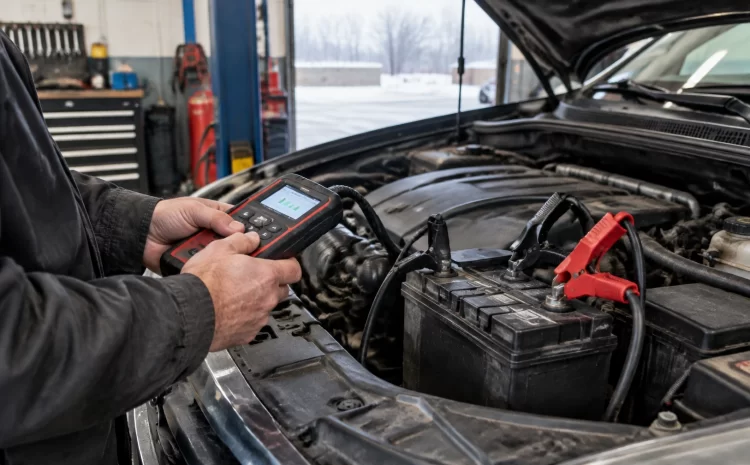
Do You Really Need a Battery Replacement? Here’s the Truth Before the First Hard Freeze
A hard freeze can turn a battery that seemed “fine yesterday” into a car that won’t start. But cold weather alone doesn’t mean you need a new battery. Replacing one too soon wastes money; waiting on a weak one can leave you stuck when you need your vehicle most.
The best way to decide is to look beyond age or a single symptom. A proper battery check considers the battery’s charge, its ability to deliver starting power, its condition, and whether the vehicle’s charging system is doing its job. Here’s how to understand those results and tell when replacement is the smart call.
Why cold weather exposes a weak battery
Your battery supplies the electrical power needed to start the engine. As temperatures drop, its ability to deliver that power falls. At the same time, a cold engine can take more effort to turn over. A battery with little reserve may manage on a mild day but struggle when the temperature drops sharply.
That doesn’t mean the first hard freeze automatically ruins a healthy battery. It reveals how much starting capacity the battery has left. A battery that’s already marginal may have enough strength for an easy start in mild weather but not enough reserve for a cold morning.
That’s why a winter decision should be based on test results, not on the forecast alone.
What a battery test should tell you
A useful test looks at more than whether the engine starts today. Ask what was tested and what the results mean for your vehicle.
State of charge: Is the battery simply low?
A battery can be healthy but undercharged. Repeated short drives, long periods parked, or an electrical drain can leave it with less charge than it needs. A low charge may affect a test result, so “low” does not automatically mean “replace.”
If a tester recommends charging and retesting, that’s an important distinction. The battery should be brought to an appropriate charge and then checked again. The AAA guide to battery test results explains why a “good. Recharge” result is different from a replacement recommendation.
Starting capability: Can it deliver the power your car needs?
Cold-cranking amps, or CCA, describe a battery’s ability to deliver starting current in cold conditions. A technician can use an appropriate battery tester to assess the battery’s starting capability and compare the result with its rating and the vehicle’s requirements.
A passing result suggests the battery can still do its job under the conditions measured. A failing result after the battery has been properly charged is a stronger reason to replace it. If the tester reports a bad cell or the battery fails a properly performed test, ask the technician to explain the result and the recommendation.
A battery should not be judged from one number without context. Charge level, temperature, battery type, and the testing procedure can all matter. If it is deeply discharged or extremely cold, it may need proper preparation before the result can be trusted.
Battery age and condition: How much weight should they carry?
Age is useful context, but it is not a verdict. Many batteries last roughly three to five years, though actual life depends on the vehicle, battery type, use, and conditions. Consumer Reports’ cold-weather battery guidance discusses that typical range.
Check the date label or code where possible, then consider it alongside the test. A younger battery that fails testing deserves attention. An older battery that passes may not need immediate replacement, but it has less margin for uncertainty, especially if dependable winter starts matter to you.
Physical damage changes the decision. A cracked, leaking, or swollen battery should be inspected promptly; don’t treat it as a “wait and see” case. Battery terminals and cable connections also matter, because a poor connection can interfere with starting even when the battery itself is serviceable.
When to replace, recharge, or wait
The decision is clearer when you separate three common outcomes.
Replace when the evidence points to a worn-out battery
Replacement is usually the sensible choice when the battery fails an appropriate test after it has been charged as needed, has a confirmed bad cell, or is physically damaged. Replacement may also be reasonable when a battery is older and testing shows little reserve, and you would rather avoid the risk of a cold-weather no-start.
If a shop recommends replacement, ask what the test showed, whether the battery was fully charged before testing, and whether the result was compared with your vehicle’s specifications. A clear explanation should connect the recommendation to the evidence.
Charge and retest when the battery is undercharged
A low state of charge can call for charging rather than immediate replacement. After charging, a retest helps show whether the battery can hold a charge and deliver the starting power your vehicle requires.
If it tests well after charging, you may not need a new battery today. But it’s worth asking why it was low. Frequent short trips, a vehicle that sits for long stretches, or an electrical draw could be contributing factors.
Keep it in service when it passes and the system checks out
If the battery is in sound physical condition, properly charged, and passes testing to the appropriate specifications, replacement may not be necessary right now. Keep the test results and pay attention to whether the battery continues to hold its charge.
A pass is not a promise that the battery will last indefinitely. It is a reasoned snapshot of its condition, and it gives you better information than replacing it based on age alone.
Make sure the battery is not being blamed for another problem
A battery that repeatedly loses charge may not be the root cause. A charging-system problem can prevent it from replenishing as it should. An electrical draw while the vehicle is off can also drain a battery. Loose or corroded connections may create trouble even if the battery tests well.
That’s why a repeat discharge deserves a broader check, not just a new battery installed by default. If the underlying issue remains, the replacement could end up with the same problem. Ask whether the charging system and battery connections were checked, and whether further diagnosis is appropriate.
Get a useful answer before winter
If you’re considering battery replacement in Bloomington, IN, ask for a decision based on the charge state, CCA or starting-capability test, battery age, physical condition, and charging-system results. A test should help you understand whether you need a replacement, a recharge and retest, or simply a plan to monitor the battery.

Dunn’s RevSports is a family-run shop with more than 70 years of combined team experience. The shop provides battery inspection and maintenance for all makes and models, including BMW, Ford, Jeep, Dodge, Toyota, and more. You can learn more about automotive repair services in Bloomington, IN or contact Dunn’s RevSports to discuss a battery check before winter.
Don’t replace a battery just because the first freeze is coming, and don’t ignore a test result that shows it has run out of reserve. Get the condition checked, understand what the results mean, and make the call with confidence.
