
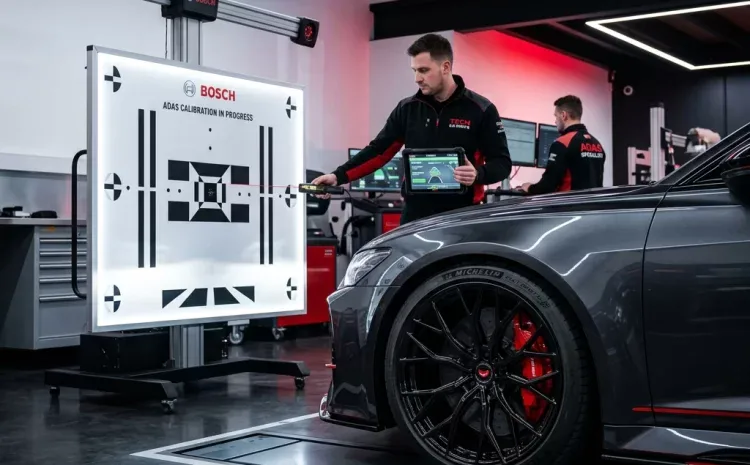
Why Everyone Is Talking About ADAS Calibration (And Why Your Custom Wheels Depend on It)
You’ve spent weeks scrolling through forums, comparing offsets, and finally pulling the trigger on that perfect set of custom wheels. You head to the shop, get them mounted, and the transformation is instant. Your ride looks aggressive, the stance is dialed in, and you’re ready to turn heads across Bloomington.
But as you pull onto the highway, something feels… different. Maybe your lane-keep assist is tugging at the wheel a bit too aggressively. Maybe your adaptive cruise control is slamming on the brakes when there’s plenty of room.
Welcome to the conversation everyone in the automotive world is having right now: ADAS Calibration.
If you’re driving a vehicle made in the last decade, it’s likely packed with “eyes” and “ears” designed to keep you safe. But here’s the kicker: when you change your wheels, tires, or suspension, you’re essentially giving your car a new perspective on the world: and if those sensors aren’t recalibrated, that perspective is dangerously skewed.
Let’s dive into why ADAS is the hottest topic in customization and why your safety depends on getting it right.
What Exactly is ADAS? (The “Brains” Behind the Beauty)
Before we talk about wheels, we need to understand the tech. ADAS stands for Advanced Driver Assistance Systems. It’s the umbrella term for all those high-tech features that make modern driving feel like the future. We’re talking about:
- Automatic Emergency Braking (AEB): Your car stops for you when it senses an imminent collision.
- Lane Departure Warning (LDW): That vibration or beep when you drift over the line.
- Adaptive Cruise Control (ACC): The system that maintains a set distance from the car in front of you.
- Blind Spot Detection: Those little yellow lights in your side mirrors.
These systems rely on a network of cameras (usually behind the windshield), radar sensors (often in the grille), and ultrasonic sensors (in the bumpers). They are precision-engineered to know exactly where the road is, where other cars are, and how fast you’re moving relative to everything else.
At Dunn’s RevSports, we love the “beast mode” look of a modified car, but we’re also obsessed with the tech that keeps that beast on the road. Understanding the benefits of safety and performance starts with respecting the sensors.

The “One Degree” Rule: Why Customization Changes Everything
So, why does a set of 20-inch wheels affect a camera mounted behind your rearview mirror? It comes down to geometry.
Imagine you’re holding a laser pointer. If you move your hand just a tiny fraction of an inch, the red dot on the wall ten feet away moves a few inches. Now, imagine that wall is 100 yards down the road. That tiny fraction of an inch at your hand becomes a massive 50-foot error at the target.
This is exactly what happens with ADAS sensors. When we install custom wheels or a suspension leveling kit, we change the vehicle’s “attitude” (its pitch and roll).
- Larger wheels might tilt the nose of the car up or down.
- Wider tires can change the steering axis.
- Lowering kits drop the sensors closer to the pavement.
If your forward-facing camera is tilted just one degree off its factory spec due to a new wheel setup, it might “see” a car in the next lane as being directly in front of you. Or worse, it might not see a hazard until it’s too late. This is why a professional alignment process is only half the battle; the “digital alignment” (calibration) is the finish line.
Why the Hype? (Safety, Liability, and the 2026 Landscape)
You might be wondering why you’re hearing about this now more than ever. There are a few big reasons why ADAS calibration is the talk of the town:
1. The Safety Stats Are Staggering
By 2026, ADAS tech is expected to have prevented millions of accidents. But these systems only work if they’re accurate. A miscalibrated sensor doesn’t just “not work”: it works wrongly. It can trigger emergency braking at 70 mph for no reason, which is a safety hazard in itself.
2. Insurance Companies are Watching
In the past, if you had a fender bender, the insurance company just looked at the bodywork. Now, if your car has ADAS, they require a calibration report. If you’ve modified your vehicle and skipped the calibration, you could find yourself in a legal grey area if an accident occurs.
3. The Tech is Getting Sensitive
Older systems were a bit more “forgiving.” Modern systems are incredibly interconnected. If your wheel alignment is out by a hair, your steering angle sensor sends the wrong data to the stability control, which then messes with the lane-keep assist. It’s a domino effect.

How Custom Wheels and ADAS Interact
At Dunn’s RevSports, we see a lot of enthusiasts who want that perfect “staggered” fitment or a specific offset to clear big brake kits. Here’s how those choices impact your sensors:
- Wheel Diameter Changes: Going from an 18-inch to a 20-inch wheel changes the circumference. Even with low-profile tires, your speedometer and your radar’s speed-sensing capabilities need to be synced.
- Suspension Geometry: Many people get custom wheels and immediately want to “gap” the wheel well with lowering springs. This changes the “pitch” of the car. If the car is tilted forward, the radar sensor is looking at the ground instead of the bumper of the car ahead.
- The Steering Angle Sensor: This is a big one. When you get an alignment for your new wheels, the steering angle sensor must be reset so the car knows exactly where “center” is. If the car thinks you’re turning when you’re going straight, the lane-keep assist will constantly fight you.
If you’re noticing any “ghost” warnings on your dash after a mod, it’s time to contact us before hitting the track or the highway.
The Dunn’s RevSports Difference: Precision in Bloomington
We get it. You don’t want to take your customized pride and joy to a generic shop that doesn’t “get” the culture. But you also can’t rely on a shop that only cares about the look and ignores the tech.
That’s where we come in. At Dunn’s RevSports, we bridge the gap between “hardcore customization” and “OE-level safety.”
Advanced Hunter Equipment
We don’t “eyeball” anything. We’ve invested in industry-leading Hunter Engineering equipment. Hunter is the gold standard for wheel service and ADAS calibration. Our systems allow us to perform “Static” and “Dynamic” calibrations that ensure your sensors are aligned to the millimeter, regardless of your new wheel specs.
Passionate Expertise
We’re not just technicians; we’re car people. We know that a vehicle is an extension of your personality. Our goal is to make sure your ride is unique and safe. Whether you’re coming in for automotive repair services in Bloomington or a full custom build, we treat your ADAS system with the same respect as your engine.

Signs Your Modified Ride Needs Recalibration
Not sure if your new wheels have thrown things out of whack? Look for these red flags:
- Dashboard Warning Lights: The most obvious sign. If the “Check ADAS” or “FCW Off” light is on, don’t ignore it.
- Unusual Steering Feel: If the car feels like it’s pulling or “searching” for the lane.
- Inconsistent Adaptive Cruise: If the car brakes too early or doesn’t slow down when it should.
- Vibrations in the Steering Wheel: Sometimes miscalibrated lane-keep systems use haptic feedback (vibrations) incorrectly.
- Parking Sensor Beeps: If your sensors are screaming at you when there’s nothing there, they’re likely aimed too low after a suspension change.
If you’re experiencing these, it’s more than just a nuisance; it’s a sign your co-pilot is confused. Check out our guide on common signs your car needs general repairs for more info on keeping your vehicle in peak shape.
Don’t Compromise Safety for Style
The trend of ADAS calibration isn’t going away. As cars get smarter, the margin for error during customization gets smaller. But that doesn’t mean you have to stay stock! It just means you need a partner who understands the “why” behind the sensors.
At Dunn’s RevSports, we’re here to make sure your custom wheels look incredible and your safety systems work flawlessly. We want you to enjoy every mile of your Bloomington drives with the peace of mind that your tech has your back.
Ready to get your stance and your sensors dialed in? Book your service today or stop by the shop to chat with our team. Let’s keep your passion for customization moving forward, safely.
